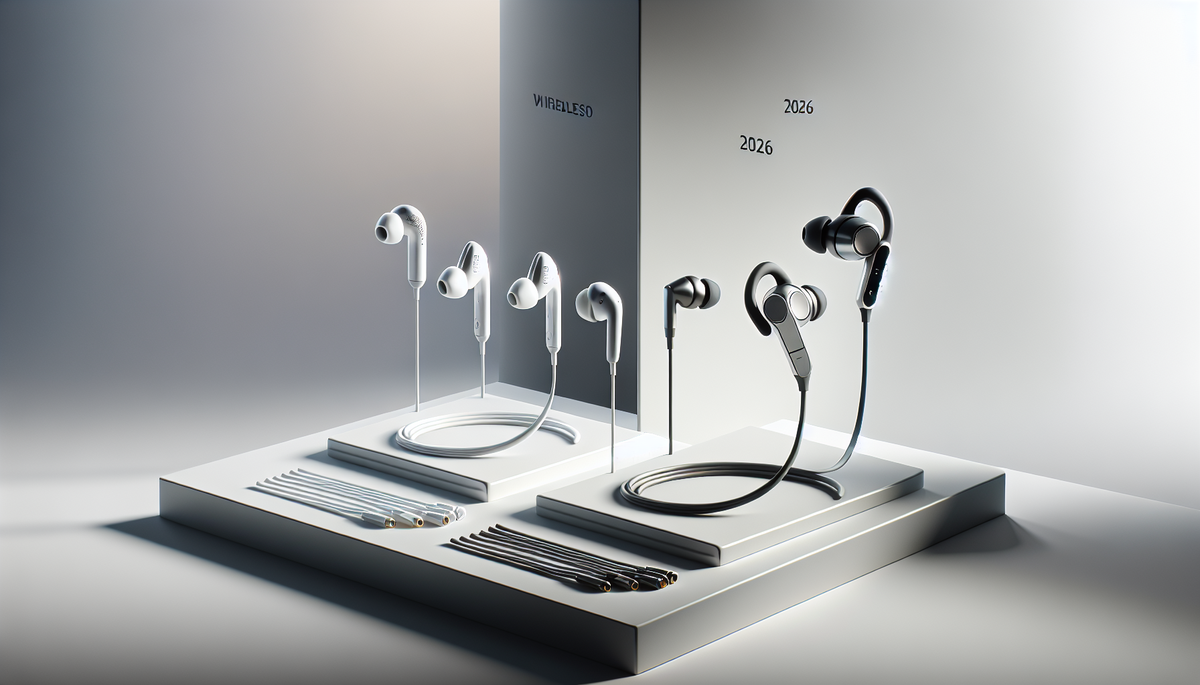
🎨 AI-generated illustration (EU AI Act 2026) — does not represent the actual appearance of the product. See the Amazon listing for official photos.
Introduction
So, you’re wondering whether to go wireless or stick with wired earphones. Honestly, it’s not as simple as “wireless is better” or “wired is better” — it depends on how you listen, where you use them, and what you care about most. In this showdown, we’ll look at the real-world differences you’ll notice: sound quality, comfort, battery life, connection reliability, and whether you’ll get annoyed by latency or tangled cables.
Get our best picks
Every week, our Amazon comparisons directly in your inbox.
No spam. Unsubscribe in 1 click.
Let’s make it easy: if you want freedom of movement, wireless is the obvious draw. If you want consistent performance with zero charging faff, wired still has a strong case. And for a lot of people, the best answer is “it depends” — but you can absolutely choose confidently once you know what to look for.
Critères de choix
- Sound quality (and consistency): Wired earphones tend to deliver a stable signal with no wireless compression. Wireless can sound brilliant too, but the quality depends on the codec support and the earphones’ tuning.
- Latency for video and gaming: If you watch lots of videos or play games on your phone, low-latency support matters. Some wireless setups are noticeably out of sync, especially with older Bluetooth versions or cheaper earbuds.
- Comfort and fit: Wireless earbuds need a good seal to sound their best. If they don’t fit properly, bass can disappear. Wired in-ear models rely on fit too, but you’re not fighting battery weight or bulk.
- Battery life vs “always ready”: Wireless means charging (and sometimes carrying a case). Wired just works — as long as your device has a headphone port or you’ve got an adapter.
- Connection reliability: Wireless can drop out in busy areas, with interference, or when you move too far. Wired is boringly dependable.
- Controls and convenience: Wireless often wins for hands-free calls, pause/play, and volume control. With wired, you’re usually reliant on inline buttons or the phone’s controls.
- Water resistance: If you’re using them for the gym, look for an appropriate IP rating. Many wireless earbuds are designed for sweat and light rain, but not all are.
- Device compatibility: Wired needs the right port (or adapter). Wireless needs Bluetooth support and usually a compatible codec for best results.
Avantages
Wireless earphones are at their best when you want to move. No cable snagging, no tugging when you turn your head, and it’s far easier to switch between listening and quick chats. They’re also brilliant for commuting: you can stash your phone away and still control music or take calls without reaching for it every time.
Sound quality has come a long way. Many modern wireless earbuds support better codecs, offer stronger noise isolation, and come with smart features like transparency mode (so you can hear announcements without removing them). If you’re the sort of person who likes podcasts, casual playlists, and everyday listening, wireless is often the most hassle-free choice.
That said, wireless has trade-offs. You’ll deal with charging and battery anxiety, and you might notice occasional connectivity quirks depending on your environment. If you’re sensitive to latency, you’ll want to check for low-latency modes before committing.
Wired earphones, meanwhile, are the champions of reliability. Plug them in and the sound is there — no pairing, no “why did they disconnect?”, no battery. For audiophiles or anyone who simply hates interruptions, wired is hard to beat. You’re also more likely to get consistently clean sound across different devices, especially if you’re using a straightforward audio output.
Wired can also be a better fit for certain use cases: studio-style listening, long sessions where battery life would be a headache, and situations where you don’t want to think about charging schedules. Plus, wired setups often work nicely with devices that don’t play well with Bluetooth.
Of course, the downside is the cable. If you’re active, cables can tangle, catch on clothing, or feel restrictive. And if your phone lacks a headphone jack, you’ll need an adapter — which is another small item to keep track of.
FAQ
Q? Do wireless earphones really sound as good as wired?
They can, but it depends. Many wireless earbuds sound excellent thanks to improved drivers and tuning, and codec support helps a lot. Wired often wins on consistency and “it just sounds the same” reliability, especially across different devices.
Q? Are wired earphones better for gaming and video?
Often, yes. Wired usually avoids Bluetooth latency completely. If you choose wireless, look for a low-latency mode or gaming-focused features, otherwise you may notice lip-sync delays.
Q? What should I prioritise if I commute a lot?
Priority usually goes to comfort, secure fit, and noise handling. Wireless earbuds with good passive isolation (and ideally transparency mode) are great for trains and buses. If you’re worried about battery, wired removes that concern entirely.
Conclusion
So, wireless or wired? If you want freedom, hands-free convenience, and a clean, clutter-free setup, wireless earphones are the easy everyday win. If you value consistency, no charging worries, and straightforward performance — especially for video, gaming, or long listening sessions — wired still makes a lot of sense.
My honest suggestion? Choose based on your routine. If your day is mostly on the move, wireless will feel natural quickly. If you’re often at a desk, watching films, or you just hate connectivity drama, wired will feel reassuringly dependable. Either way, you’ll end up with something you actually enjoy using — and that’s the real goal.
Our picks — Wireless earphones vs wired earphones: the 2026 showdown
Apple AirPods Pro (2nd Gen, USB‑C)
Active noise cancelling with a comfortable in‑ear fit.
Samsung Galaxy Buds2 Pro
Hi‑Fi sound with adaptive noise control and great call quality.
Sony WF‑1000XM5
Premium noise cancelling and detailed audio for everyday use.
Bose QuietComfort Earbuds II
Strong ANC performance and balanced sound with comfort.
Sennheiser IE 200 (wired in‑ear)
Natural, detailed wired sound with a comfortable in‑ear design.
🔗 Affiliate links : Some links on this page are Amazon affiliate links. As an Amazon Associate, we earn from qualifying purchases at no extra cost to you.
🏆 Top 5 — Best wireless earbuds
↻ Mis à jour le 11/04/2026 · Données 2025-2026