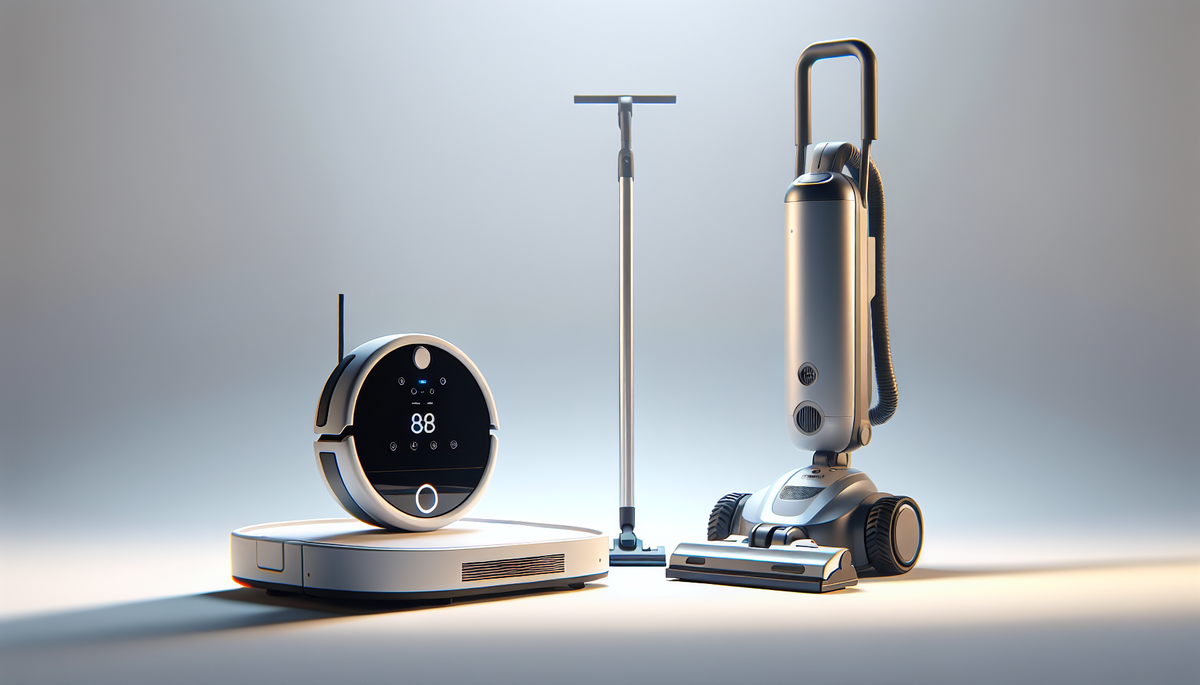
🎨 AI-generated illustration (EU AI Act 2026) — does not represent the actual appearance of the product. See the Amazon listing for official photos.
🔗 Affiliate links : Some links on this page are Amazon affiliate links. As an Amazon Associate, we earn from qualifying purchases.
Get our best picks
Every week, our Amazon comparisons directly in your inbox.
No spam. Unsubscribe in 1 click.
Introduction
Choosing between a robot vacuum and a traditional vacuum can feel a bit like deciding between “set it and forget it” and “get stuck in yourself”. Both can keep your floors looking great, but they shine in different situations. A robot vacuum is brilliant for day-to-day maintenance, while a traditional vacuum often wins when you want deeper cleaning, especially in busy households.
In this guide, I’ll walk you through what actually matters—so you can pick the option that fits your home, your habits, and your expectations.
Critères de choix
- Type of flooring: If you’ve got a lot of carpets, look at suction power and brush design. For hard floors (wood, laminate, tiles), navigation and edge-cleaning matter more than maximum power.
- Pet hair and allergies: If you’ve got pets—or you’re sensitive to dust—prioritise strong suction, effective brush systems, and good filtration. A robot can help with frequent cleaning, but you still need to empty it regularly.
- Home layout: Robots do well with open-plan spaces and predictable obstacles. If your home has lots of tight corners, thresholds, or clutter, a traditional vacuum will be more reliable.
- Obstacle handling: Consider how the robot reacts to cables, socks, and chair legs. Some models are better at avoiding mess than others, and that can make or break the experience.
- Battery life and coverage: Check whether the robot can handle your whole home on one charge (or whether it needs multiple cycles). For larger homes, this matters a lot.
- Emptying and maintenance: A robot may save time, but it still needs care—cleaning brushes, emptying the dust bin, and clearing tangled hair. Some models offer self-emptying bases, which is a big plus.
- Noise level: Traditional vacuums can be loud, especially on high power. Robots are usually quieter, so you can run them while you’re in the house.
- Control and scheduling: If you want automatic cleaning, scheduling features are essential. You’ll also want easy app control so you can start, pause, or target specific rooms.
- Budget and value: Robot vacuums often cost more upfront. Traditional vacuums can be cheaper, but you might spend more time—and possibly more money over time if you replace attachments or filters.
Avantages
Robot vacuum advantages are all about convenience and consistency. Once it’s set up, it can run daily or every couple of days, which helps stop dust and crumbs building up in the first place. That’s especially handy if you’re juggling work, kids, or just living a normal life without wanting to vacuum every evening.
Robots are also great for maintenance in between deeper cleans. They can reach under some furniture and along edges more often than most people manage manually. And because they typically run in short cycles, they can be less of a chore—plus, many are quiet enough to run while you’re at home.
Traditional vacuum advantages come into play when you want thorough cleaning. You can choose the right head for the job, use the right suction level, and tackle stubborn areas properly—think stairs, skirting boards, corners, and upholstery. If you’ve got thick carpets or a lot of ground-in dirt, a good traditional vacuum is often more effective in one go.
There’s also the reliability factor. A traditional vacuum doesn’t get confused by a stray cable or a pile of laundry. It’s straightforward: you move it, and it cleans. And when you’ve got a spill or you’re doing a proper spring clean, you’ll usually feel more in control with a manual vacuum.
One more thing: many people end up with a “best of both worlds” approach. A robot handles daily upkeep, while the traditional vacuum steps in for deeper cleaning and those awkward spots the robot can’t quite master. Honestly, that combo can be a real sweet spot.
FAQ
Q?
Which is better for pet hair: robot vacuum or traditional vacuum?
Q?
Do robot vacuums work well on carpets?
Q?
How often will I need to clean and maintain a robot vacuum?
Conclusion
If you want convenience, a robot vacuum is hard to beat—especially for keeping hard floors and everyday dust under control. It’s the “little and often” approach, which tends to make your home feel cleaner with far less effort.
If you want deep, reliable cleaning, particularly on carpets, stairs, and tricky corners, a traditional vacuum is usually the safer bet. You’ll get stronger results when it really matters, and you won’t have to worry about navigation hiccups.
Ultimately, the best choice depends on your home and your routine. If you tell me what flooring you’ve got, whether you’ve got pets, and roughly how big your place is, I can help you narrow it down to the option that’ll feel like the easiest win for you.