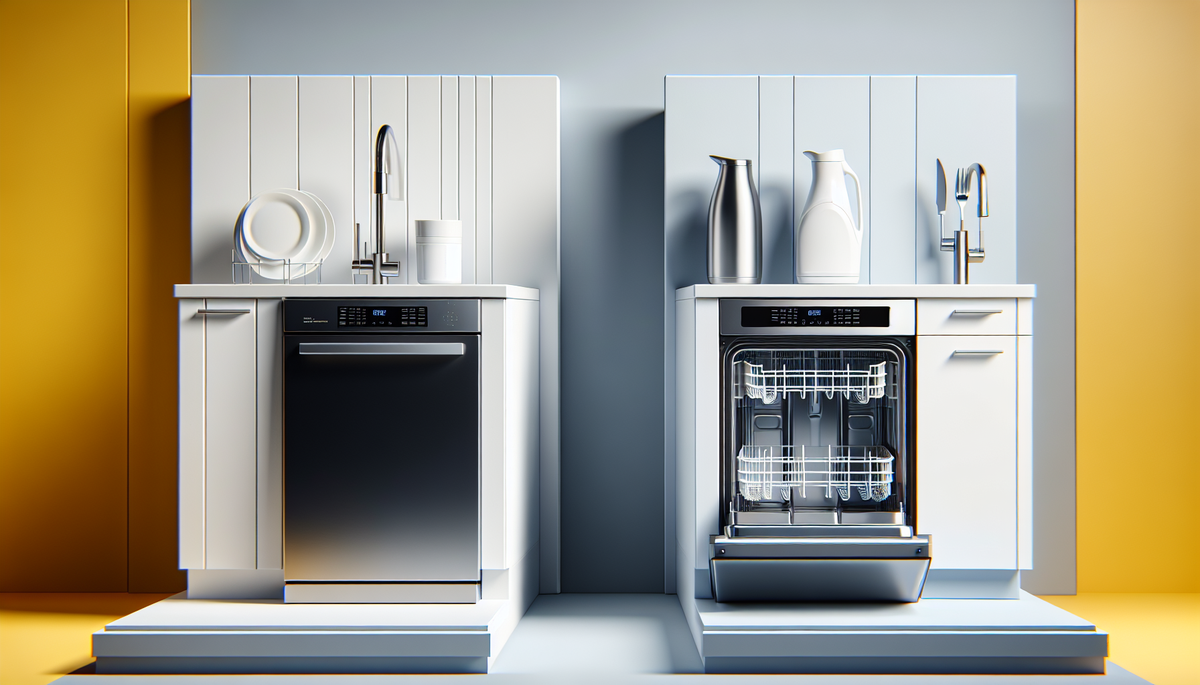
🎨 AI-generated illustration (EU AI Act 2026) — does not represent the actual appearance of the product. See the Amazon listing for official photos.
🔗 Affiliate links: Some links are Amazon affiliate links. As an Amazon Associate, we earn from qualifying purchases at no extra cost to you.
Get our best picks
Every week, our Amazon comparisons directly in your inbox.
No spam. Unsubscribe in 1 click.
Introduction
Are you torn between a built-in dishwasher and a portable model? That’s perfectly normal: they’re two quite different approaches, each with its own advantages. The right choice depends mainly on your kitchen, your way of living (and cleaning), and what you want from it day to day.
In this guide, we compare the two options simply: installation, footprint, capacity, ease of use and budget. The idea is to help you quickly spot what best suits your situation, without unnecessary jargon.
Selection criteria
- Your kitchen and installation constraints
A built-in dishwasher fits into a unit and generally requires a water connection (and sometimes a bit of preparation depending on the layout). A portable one, on the other hand, can often be placed almost anywhere, then easily connected to a nearby water supply. - Available space
Built-in models are often designed to blend neatly into a fitted kitchen. Portable models are more flexible, but they can take up space on a worktop or on the floor. If your kitchen is compact, a portable model may be more practical… or, depending on where it sits, it may get in the way. - Capacity and number of place settings
In general, built-in models offer volumes better suited to families or regular use. Portable models can work very well for one or two people, or if you run cycles more frequently. - Water and energy consumption
Both types can be efficient, but the difference often comes down to the energy rating, the programmes available and how you load the appliance. A dishwasher that is well filled and run at the right time uses less than you might think. - Noise level
If you live in an open-plan space or run cycles in the evening, noise matters. Built-in models are sometimes quieter thanks to their integration. Portable models can also be fine, but check the stated decibel level. - Ease of use
Some portable models are very easy to use: plug it in, set it up, and off you go. Built-in models require more initial setup, but once installed, they’re easy to forget about. - Programmes and options
Look for quick, eco, intensive or glass programmes. Options such as delayed start, effective drying or load sensing can make a real difference, especially if you’re running meals back to back. - Budget and overall cost
The purchase price is the obvious factor, but don’t forget installation. A built-in model can cost more upfront if you need to adapt the space or carry out connections. A portable model may seem more affordable, but you still need to consider the footprint and water connection.
Advantages
Built-in dishwasher: the main advantage is integration. It disappears into your kitchen, gives a more harmonious finish, and is ideal for regular use. If you like a kitchen that feels “finished”, with everything in its place, it’s often the best choice. In terms of performance, many built-in models offer good capacity and a wide range of programmes to handle both everyday dishes and more stubborn, stuck-on food.
Portable dishwasher: the number one advantage is flexibility. Ideal if you rent, if you don’t want to alter the existing installation, or if you don’t have space for a built-in unit. You can move it as needed, place it near a water source, and use it without major work. For small households or for more ad hoc use, it’s often very practical. And if you like to keep as much freedom as possible at home, a portable model has a reassuring side to it.
In short: a built-in model focuses on long-term comfort and integration, while a portable model focuses on ease of use and adaptability. The right choice therefore depends on your home, your mealtime routine, and how much “small installation hassle” you’re willing to accept.
FAQ
Q1: Which type is best for a small kitchen?
If you don’t have the space or don’t want a complicated installation, a portable model may be easier to set up. On the other hand, if you have a space already planned for a built-in model, it may blend in better and free up the worktop.
Q2: Does a portable dishwasher clean as well as a built-in one?
Yes, provided you choose a model with suitable programmes and good washing capacity. The quality depends as much on the brand, the settings and how you load the appliance as it does on whether it is built-in or portable.
Q3: Which is the most economical day to day?
It mainly depends on energy efficiency, the programmes used and how often you wash. A well-filled eco model can be very cost-effective, whatever the type. A portable model can also be a good option if you only use it when needed, without running half-empty cycles.
Conclusion
Ultimately, the choice between a built-in dishwasher and a portable model comes down to one simple question: are you mainly looking for integration and peace of mind, or flexibility and ease of setup?
Choose a built-in model if you want a harmonious kitchen, comfortable capacity and regular use. Choose a portable model if you need mobility, if you rent, or if you’d rather avoid work. In both cases, take the time to check capacity, programmes and noise level: these are the details that will make the difference day to day.